What Is an Autonomous AI Agent? (In plain English)
"AI agent" is one of those phrases that gets thrown around constantly and explained almost never. So let's fix that — no jargon, no hype. Here's what an autonomous AI agent actually is, how it's different from the AI you already know, and why the distinction is the whole ballgame.
Start with what you already know: the chatbot
You've used ChatGPT or something like it. You type a question, it types an answer. You ask it to write an email, it writes the email. That's a chatbot, and it's genuinely useful — but notice the pattern:it only does something when you prompt it.Itwaits. It responds. Then it stops and waits again. You are the engine. The chatbot is a very smart tool sitting in your hand, and nothing happens unless you pick it up and use it. Every single action requires you to be there, typing.
Now the shift: an agent acts on its own
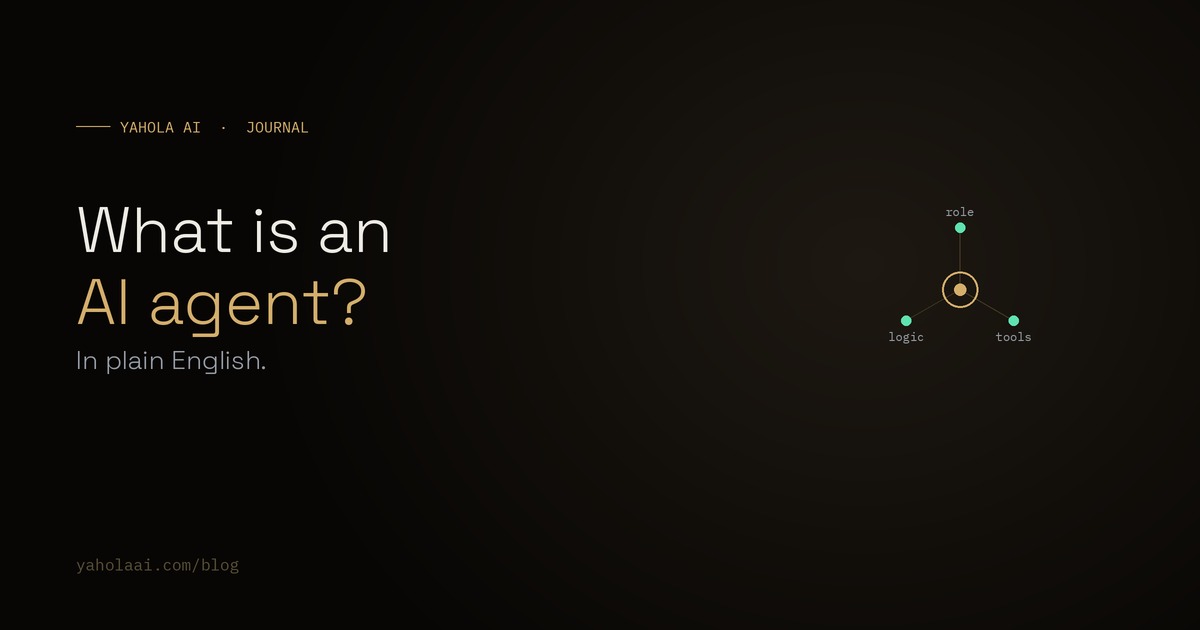
An autonomous AI agent flips that. Instead of waiting for you to prompt it every time, an agent is given ajob, a set oftools, andrules for how to decide— and then it goes and does the job on its own. It doesn't need you to type "now do the next step." It figures out the next step and takes it. Think of the difference this way: a chatbot is a really capable assistant who only moves when you give a direct order. An agent is an employee who knows their role, has access to what they need, and justdoes the work— checking in when it matters, but not waiting on you for every action.
The three things that make an agent an agent
Under the hood, an autonomous agent has three parts that a chatbot doesn't. First, a defined role and goal — not "answer whatever's typed," but a specific job like "follow up with every new lead until they book or opt out." Second, tools — real access to the things it needs to act, like your calendar, your CRM, your email, or your social accounts. A chatbot canwritea follow-up email; an agent can actuallysendit. Third, decision-making rules — logic for what to do in different situations, so it can handle "if the lead replies, do this; if they go quiet for three days, do that" without asking you each time. Role, tools, and judgment. That combination is what lets it operate instead of just respond.
What that looks like in real life
Picture a lead filling out a form on your website at 11 p.m. A chatbot does nothing — it's waiting for someone to prompt it. An agent, on the other hand, notices the new lead immediately, sends a personalized reply, offers times to book a call, logs the lead in your CRM, and sets a reminder to follow up in two days if there's no response — all while you're asleep. You didn't type a thing. You wake up to a handled lead and a booked call. That's the difference between a tool that helps you work and a system that does the work.
Why this distinction actually matters
Here's why this isn't just semantics. If you think AI means "a smarter tool I operate," you'll spend your time learning to operate tools — and you'll still be doing all the work, just faster. If you understand that AI can be anagent that operates on its own, a different door opens: work that happens without you in it. That's the leap fromusingAI todeployingit. One saves you a few minutes per task. The other takes the task off your plate entirely. Most of the AI conversation is stuck on the first idea. The real leverage is in the second.
The bottom line
A chatbot is a tool you use. An autonomous agent is a worker you deploy. Both are "AI," but they change your business in completely different ways — one makes you faster, the other makes you free. Once you see that difference, you stop asking "how do I use AI" and start asking "what could I hand to an agent." And that second question is where everything interesting starts.
Curious what an agent could take off your plate? Book a discovery call and we'll map it — or start with the free guide,5 Jobs Your Business Could Hand to AI Agents This Month.